Speed Is the New Strategy: Inside the 72-Hour Content Production Cycle
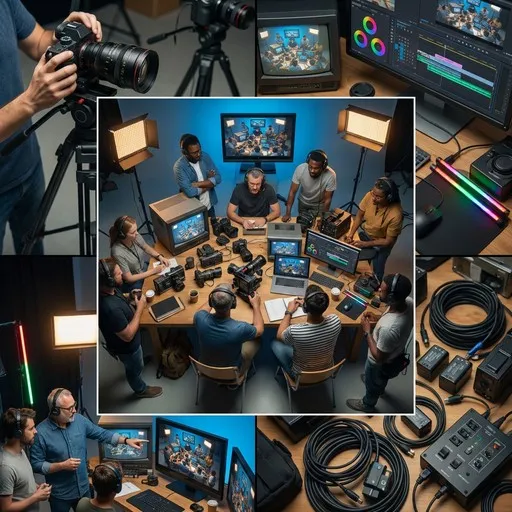
Photo: creative team collaborating on video production in modern studio, via images.stockcake.com
Not long ago, a brand video campaign moved through a predictable sequence: brief, concept development, pre-production, shoot, post-production, rounds of revision, legal review, and finally distribution. The entire process might consume six to eight weeks on a compressed schedule—and that was considered efficient. Today, some of the most effective brand content in circulation was conceived, produced, and published within three days.
This compression is not accidental, and it is not merely a response to shrinking budgets. It reflects a fundamental change in how audiences consume content, how platforms reward recency, and how production technology has redistributed capability. The 72-hour content cycle has become a genuine competitive differentiator, and the brands and agencies that have internalized it are operating at a different pace than those still anchored to legacy timelines.
The Forces Compressing the Timeline
Several developments have converged to make rapid production not only possible but expected.
Cloud-based collaboration platforms have effectively eliminated geography as a production constraint. An editor in Austin can receive raw footage from a shoot in Chicago, begin cutting while a colorist in Atlanta reviews reference frames, and deliver a first cut for client feedback before the production crew has packed down the location. Tools such as Frame.io, which integrates directly into Adobe Premiere Pro, allow stakeholders to leave time-coded comments on video files without specialized software or lengthy email chains. What once required a physical edit suite and scheduled review sessions now happens asynchronously across time zones.
Artificial intelligence has further accelerated specific post-production tasks. Automated transcription, noise reduction, color matching, and even rough-cut assembly can now be accomplished in minutes rather than hours. These capabilities do not replace skilled editors and producers—they eliminate the mechanical delays that once padded timelines without adding creative value.
At the same time, platform algorithms have increasingly rewarded content that responds to cultural moments in near-real time. Brands that can produce relevant, on-brand content within hours of a trending conversation capture organic reach that no paid amplification budget can replicate. This dynamic has created a business case for speed that did not exist when social media moved at a slower tempo.
What Production Leaders Are Actually Saying
The shift toward compressed timelines has generated genuine debate among production professionals. The consensus, such as it is, is complicated.
"The tools are not the obstacle anymore," says one executive producer at a mid-sized content agency in New York who works with national retail and consumer packaged goods clients. "The obstacle is the approval process. We can turn around a polished 60-second piece in 48 hours. Getting sign-off from three internal stakeholders and a legal team in that same window—that's where the timeline breaks down."
This observation surfaces repeatedly in conversations with production leaders. The technology has outpaced the organizational structures through which brand content is approved and released. Companies with flattened decision-making hierarchies and pre-cleared brand guidelines can move at production speed. Those with traditional multi-layer review processes find that the bottleneck has simply migrated upstream.
A creative director at a Los Angeles-based digital agency that produces content for technology and lifestyle brands frames the challenge differently: "We've had to be honest with clients about what rapid turnaround actually means for craft. It doesn't mean low quality—it means different quality. The color grade might be tight rather than obsessive. The sound mix will be clean but not theatrical. The goal is fit-for-purpose excellence, not award-reel perfection."
That distinction—fit-for-purpose excellence—has become something of a governing philosophy for agencies operating in the fast-production model.
The 'Good Enough Fast' Doctrine and Its Limits
The phrase that circulates most frequently in discussions of rapid content production is some variation of "good enough fast beats perfect and late." It is a pragmatic acknowledgment that content with a short shelf life—a trend response, a product launch reaction, a cultural moment tie-in—derives its value from timeliness rather than technical refinement.
This doctrine has genuine merit in specific contexts. A brand that publishes a well-conceived, cleanly executed piece of content within 24 hours of a relevant cultural event will almost always outperform a more polished piece published a week later, when the moment has passed and the algorithm has moved on.
However, experienced production professionals are careful to identify the boundaries of this principle. Brand equity is cumulative, and content that consistently underdelivers on production quality erodes the visual authority a brand has worked to establish. The 72-hour cycle is most appropriately applied to reactive, platform-native content—not to brand films, campaign anthologies, or content intended to anchor long-term marketing strategy.
"We think about our content in tiers," explains a brand content manager at a consumer electronics company based in the Pacific Northwest. "Tier one is evergreen—high production value, long shelf life, significant investment. Tier two is campaign-specific, moderate production, two to three week cycle. Tier three is reactive and platform-native—that's where the 72-hour model lives. Trying to apply one production standard across all three tiers is where brands get into trouble."
Rebuilding the Approval Architecture
For agencies advising brand clients on rapid production adoption, the most consequential work often happens before a single camera is turned on. Establishing the organizational conditions that allow fast content to move through approval without sacrificing brand integrity requires deliberate structural changes.
Pre-approved brand frameworks—detailed guidelines covering visual language, tone, messaging boundaries, and legal clearance parameters for specific content categories—allow production teams to operate with confidence and speed. When a reactive content opportunity emerges, teams working within a pre-approved framework can proceed without initiating a full review cycle.
Delegated approval authority is equally important. Designating a single brand-side stakeholder with the authority to approve fast-cycle content, rather than routing through a committee, compresses the review window from days to hours. This requires organizational trust and clearly defined accountability—neither of which emerges without intentional effort.
The Competitive Arithmetic of Speed
The brands winning the content competition in 2025 are not necessarily those with the largest production budgets or the most sophisticated creative teams. They are the brands that have built operational agility into their content function—that can recognize an opportunity, mobilize a production response, and publish with confidence before the window closes.
For agencies and production companies, this represents both a challenge and a clear value proposition. The ability to deliver quality content at velocity—not as an occasional sprint but as a sustained operational capability—is increasingly what separates partners who drive brand growth from those who merely execute briefs.
At Sky Media Digital, we have built our production infrastructure around exactly this capability. Fast does not mean careless. It means prepared, streamlined, and aligned with how modern brands actually compete for attention. The 72-hour cycle is not a compromise. For the right content, in the right context, it is the highest-leverage tool available.