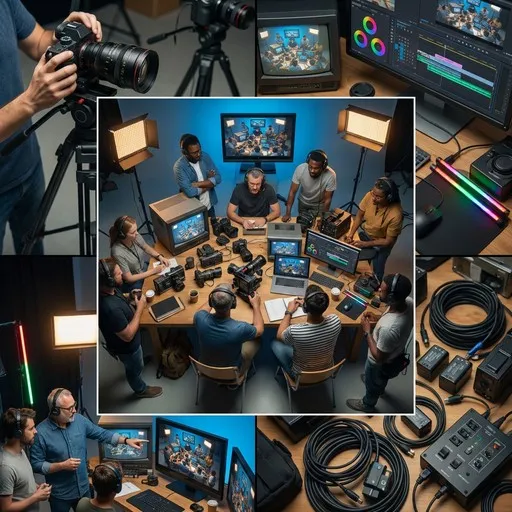
Polish Is Losing: Why Raw, Real-Time Content Is Outperforming Big-Budget Brand Video
For decades, the prevailing logic in brand marketing was straightforward: spend more, look better, win audiences. A six-figure production budget, a seasoned director, and a meticulously color-graded final cut were considered non-negotiable markers of a brand that took itself seriously. That logic is now being challenged — and in many cases, dismantled — by a generation of consumers who have developed a remarkably precise instinct for detecting the distance between a brand and its actual identity.
Call it the authenticity tax. The more a brand invests in making its video content look perfect, the more it risks communicating something audiences increasingly distrust: that the brand is performing rather than being.
The Shift No Production Budget Could Have Predicted
The cultural turning point did not happen overnight, but it accelerated sharply in the early 2020s as short-form platforms — TikTok in particular — rewired audience expectations at scale. American consumers, already accustomed to scrolling through a feed populated by creators filming on smartphones in their living rooms, began applying a new standard to brand content: does this feel real, or does this feel manufactured?
The answer, for many traditionally produced brand videos, was the latter. High production value had become a visual cue not for quality, but for inauthenticity. Smooth camera movements, studio-perfect lighting, and scripted dialogue began to read as signals that a brand was trying too hard — or worse, hiding something behind the gloss.
Research supports what creators and brand strategists have been observing anecdotally. Studies consistently show that consumers, particularly those under 40, rate relatability and honesty significantly higher than production quality when evaluating branded content. The finish line has moved.
Case Studies in Strategic Imperfection
Several well-known American brands have already made the pivot, with measurable results.
A regional fast-casual restaurant chain in the Midwest abandoned its quarterly brand video campaign — complete with food stylists, hired talent, and a full post-production workflow — in favor of daily behind-the-scenes content filmed by kitchen staff on personal devices. Engagement on their social channels tripled within 90 days. The content was grainier. The lighting was inconsistent. The captions occasionally had typos. Audiences responded as though they had finally been invited into a space that was previously off-limits.
A direct-to-consumer skincare brand based in Los Angeles made a similar decision after noticing that user-generated content featuring their products was consistently outperforming their studio-produced ads in both reach and conversion. Rather than fighting the trend, they restructured their content strategy around founder-led, unscripted video updates — often filmed in a single take — that addressed customer questions, product challenges, and even manufacturing delays with candid transparency. The brand's social following grew by 40 percent in six months.
These are not isolated cases. They represent a pattern that brand strategists across industries are now contending with seriously.
The Psychology Behind the Preference for Imperfection
Understanding why audiences respond this way requires looking at the psychological mechanics of trust formation. Human beings are wired to detect incongruence — the subtle mismatch between what someone says and how they say it. Overly produced content, particularly when it attempts to simulate spontaneity, often triggers this detection system. Audiences may not be able to articulate why a video feels inauthentic, but they feel it immediately.
Raw, unfiltered content bypasses this mechanism precisely because it is not trying to simulate anything. The shaky handheld shot, the ambient background noise, the unrehearsed pause — these elements communicate that what the viewer is watching is happening in real time, without the intervention of a post-production team whose job is to make everything look intentional.
There is also a parasocial dimension at play. When a brand communicates through polished, produced video, it maintains a formal distance from its audience. When it communicates through rough, real-time content, it collapses that distance and invites a more personal form of connection — the same kind that fuels the loyalty audiences feel toward their favorite individual creators.
What This Means for Brand Video Strategy
None of this suggests that professional video production is obsolete. High-production content still serves critical functions: brand launches, product demonstrations, broadcast advertising, and long-form storytelling all benefit from the craft and intention that a skilled production team brings. The mistake is treating polished video as the default for every format and platform, regardless of context.
The more sophisticated strategic position is one of intentional contrast. Brands that understand this moment are building content ecosystems where high-production pieces anchor their identity at key touchpoints, while real-time, lo-fi content handles the ongoing work of relationship-building and audience engagement. Each format earns its place based on what it is actually trying to accomplish.
At Sky Media Digital, we observe this tension constantly in our work with brands navigating multi-platform content strategies. The question is never simply whether to produce or not to produce — it is whether the level of production serves the communication goal, or whether it inadvertently undermines it.
Redefining Quality in the Current Landscape
The most important reframe for brand leaders and marketing teams is this: quality is no longer synonymous with production value. Quality now means resonance. It means the degree to which content connects with its intended audience in a way that feels genuine and earns their continued attention.
A 90-second video filmed in a single take by a brand founder who speaks directly into the camera with honesty and specificity can be higher quality — by this definition — than a $200,000 brand film that was focus-grouped, revised, and produced to within an inch of its life.
Brands that internalize this distinction will be better positioned to allocate their production resources strategically, rather than reflexively. The ones that do not will continue paying the authenticity tax — spending more to reach fewer people who trust them less.
The audience has already made its preference clear. The remaining question is how quickly brands will choose to listen.